
Policy Brief
Gendered Political Economy

Digital Welfare and Women’s Exclusion in India: How Aadhaar-linked Systems Affect Informal Women Workers

Nearly half (51%) of rural Indian women aged 15 and above lack mobile phones, a basic enabler of digital welfare access, underscoring how rapidly expanding Aadhaar-linked social programs risk excluding the very populations they…

Written byParneet Kaur
Published on23 February 2026
raahpolicy.orgResearch, Analysis & Advisory Hub

At a glance

Summary

Nearly half (51%) of rural Indian women aged 15 and above lack mobile phones, a basic enabler of digital welfare access, underscoring how rapidly expanding Aadhaar-linked social programs risk excluding the very populations they intend to support.

PublicationPolicy Brief
FieldGendered Political Economy
Author Parneet Kaur
Affiliation Founder at Research, Analysis and Advisory Hub (RAAH)
Published23 February 2026

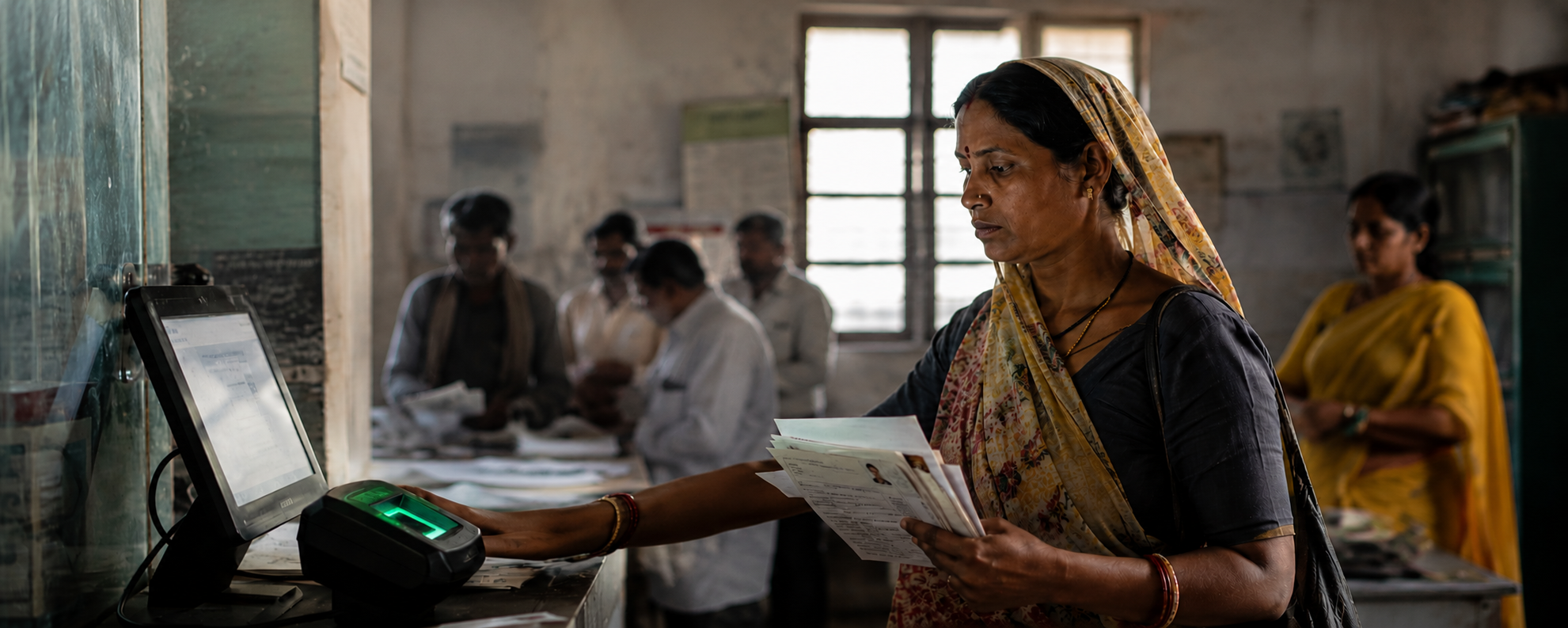
Nearly half (51%) of rural Indian women aged 15 and above lack mobile phones, a basic enabler of digital welfare access, underscoring how rapidly expanding Aadhaar-linked social programs risk excluding the very populations they intend to support. India’s digital welfare architecture, from e-Shram worker registries to Aadhaar biometric authentication for subsidies and pensions, was designed to reduce leakage and improve targeting. Yet, documented biometric authentication failures, data mismatches, and internet access deficits leave millions without entitlements they are eligible for, particularly informal women workers with lower digital access, literacy, and independent documentation. Studies show that digital barriers disproportionately affect informal workers, who comprise over 70% of the non-agricultural workforce, and women’s exclusion is compounded by socio-cultural constraints and device access gaps that undermine their ability to complete Aadhaar-linked registration and authentication processes.

Without robust offline alternatives and supportive digital literacy interventions, these systems risk transforming welfare from inclusive safety-net instruments into systemic exclusion mechanisms that weaken social protection and deepen gender inequities. To reverse this trend, policy architecture must reduce over-reliance on mandatory digital authentication where feasible, strengthen assisted registration and grievance redressal frameworks, and invest in gender responsive digital inclusion, including subsidised access to devices, community facilitation centres, and simplified identity reconciliation, so that Aadhaar functions as an instrument for inclusion rather than exclusion.


Given India’s ongoing scaling of digital public infrastructure and expansion of mandatory e-KYC requirements across several state welfare programs, timely design recalibration is critical to safeguard women’s access to essential benefits and realise the equity goals of India’s social protection agenda.

Policy Design Priorities
  • Embed layered authentication pathways to minimise denial risks without compromising system integrity.
  • Institutionalise assisted registration and grievance redressal mechanisms at the last mile, particularly for informal women workers.
  • Expand gender-responsive digital inclusion infrastructure, including device access support and community facilitation models.
  • Conduct periodic exclusion diagnostics and authentication audits to assess distributional impact across vulnerable groups.

About the Author

Parneet Kaur

Parneet Kaur

Founder at Research, Analysis and Advisory Hub (RAAH)

Parneet Kaur, the founder of RAAH, is a public policy professional with experience across legislative research, policy analysis, and governance practice in India. She has worked with the Rajya Sabha Secretariat, the Office of Member of Parliament, and the Ministry of Rural Development, engaging with policy processes at the intersection of institutions, programs and implementation.

About RAAH

The Research, Analysis & Advisory Hub (RAAH) is a public policy institution working to strengthen evidence-informed public decision-making and effective governance.

RAAH brings together policy research, structured learning, and applied analysis to examine complex public systems and strengthen the capacity of individuals and institutions to respond to policy challenges with analytical rigour and implementation awareness.

RAAH’s work spans policy education and capacity building, research, and selective institutional engagement. Through these areas, RAAH works with emerging policy professionals, practitioners, and institutions to engage with real-world policy questions and develop responses that are evidence-informed, context-sensitive, and operationally viable.

RAAH publishes research and policy analysis across areas including governance, social policy, livelihoods, digital systems, climate resilience, emerging technologies, economic policy, agriculture, and international affairs.

Disclaimer

RAAH does not take institutional positions on public policy issues; the views represented herein are those of the author(s) and do not necessarily reflect the views of RAAH.

Research, Analysis & Advisory Hub
RESEARCH, ANALYSIS & ADVISORY HUB (RAAH) raahpolicy.org · [email protected] · LinkedIn © 2026 Research, Analysis & Advisory Hub (RAAH). All rights reserved.