Assessing the Structural, Economic and Policy Foundations of India’s Emerging Millet Economy
Abstract: India’s push to reposition millets as “smart foods” and climate-resilient crops has emerged as a significant component of its agricultural and food-security strategy. While the International Year of Millets 2023 generated global visibility and strengthened India’s soft-power positioning, long-term success depends on overcoming structural constraints within production systems, supply chains and value addition networks. This article examines the international millet economy, the evolving dynamics of India’s domestic millet sector, and the role of state-led interventions in transforming millets from subsistence crops into competitive, value-based commodities. It argues that sustained institutional support, technological innovation and market integration will determine whether India’s millet strategy evolves into a durable model of nutritional security, climate resilience and rural economic transformation.
Introduction
The ‘International Year of Millets 2023,’ an international endeavor to rebrand millets and promote them as a component of the modern food system, was hailed as a great success by the Indian Government. This was not only due to its implications for India’s soft power but the direct
economic benefit the same produced for India (which currently serves as the largest producer of millets globally). However, the creation of international demand is not sufficient in the absence of supply chain expansion, optimisation, and innovation. This article provides a brief overview of the international millet economy, the local millet economy, and the role played by government schemes in facilitating and optimising production.
The International Economy
In 2023, global millet production stood at approximately 94.1 million tonnes, reflecting modest recovery after earlier declines (despite expansion in cultivated area). This indicates that even as the interest in millets increases, there are still productivity challenges which continue to persist. The global production environment is geographically distributed. India provides about 18.7% of the total output, followed by the United States, Nigeria and a host of African economies. Nevertheless, the composition of production shows that there is a crucial difference. Sorghum (primarily utilised as livestock feed) is the dominant millet in the whole world in terms of production, comprising over two-thirds of total millet production. Conversely, in India, millet production is geared towards direct human consumption. Pearl millet (bajra) takes the lead, followed by sorghum (jowar) and finger millet (ragi).
This dislocation of industrial and food applications is a key determinant of global trade relations. Countries like the United States and Australia have a high export orientation due to the demand of feed grains. Meanwhile, China has become the biggest importer with a large proportion of global imports; these are primarily utilised to feed its growing livestock industry. In this manner, the international millet economy is organized not around human nutrition but around industrial and feed needs.
The Indian Context
In this international system, India holds a unique but limited position. It is both the largest producer and consumer of millets but is only marginally integrated in the global export market. This indicates domestic demand is high but also communicates deeper structural bottlenecks. Non-tariff barriers, the lack of standardised testing and certification infrastructure, and the absence of harmonised classification systems of processed millet products are some of the reasons why India is not participating extensively in global markets. These restrictions curtail value addition and make millets (as a cereal) less competitive compared to those that are traded globally (such as rice and wheat).
This picture is further complicated by the internal dynamics of the Indian millet economy. In the past, millets have played a central role in Indian agriculture. They constituted about 40% of the cropped land before the Green Revolution. But due to policy support being extended to high yielding varieties of rice and wheat, as well as changes in consumer preferences towards processed foods, the cultivation of millets sharply declined. Over the past few years, some renewed interest has emerged. This has primarily been fuelled by nutritional awareness, environmental issues and government policies. Although fluctuating, the production levels have stabilised, with the output reaching approximately 17-18 million tonnes and the production levels showing signs of incremental growth.
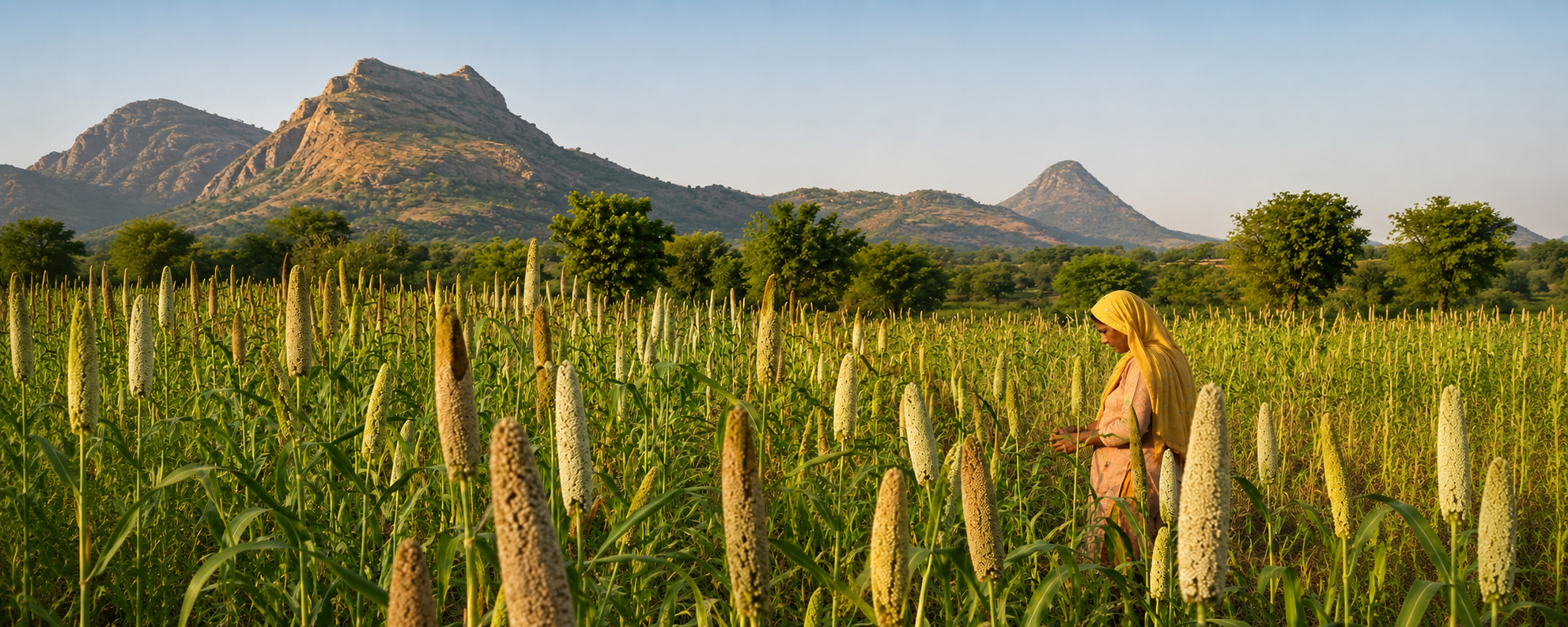
This growth is uneven in terms of space and composition. The production of millets is extremely concentrated in a small number of states, primarily Rajasthan, which between them furnish about 90% of national production. The production mix has been primarily dominated by bajra which comprises over 65% of the same. Meanwhile, India produces a great variety of both large and small millets, such as foxtail, kodo and barnyard millet. This diversity is an opportunity of differentiating markets, as well as a challenge of standardisation. On an economic front, the industry still experiences structural disincentives. Despite minimum support price (MSP) measures, the returns at the farm-level in millet production are still comparatively low (relative to rice and wheat). This limits commercialisation of large-scale millet cultivation.
However, there is a slow change that is taking place. There is a growing trend to reposition millets as high value, ‘smart foods.’ Moreover, there is an increasing demand in health-conscious and vegan markets for value-added millet foods such as millet flour, millet flakes, and ready-to-eat foods. Thus, the millet economy, both around the world and in India, can be described in terms of the conflict between traditional roles and new opportunities. The task here is to fill this gap; to turn millets into a competitive, value-based commodity without having to sacrifice their ecological and nutritional value.
Government Measures
To solve this, the Indian government has adopted a holistic strategy to reposition millets as nutri-cereals both locally and internationally. In regard to the global context, the role of India in the declaration of the ‘International Year of Millets 2023’ made these crops marketable as ‘climate-friendly’ and ‘healthier alternatives.’ This initiated a resolution of the demand-side issue (which has unfortunately plagued millets). On the domestic front, government policy actions are focused on optimising the value chain (hoping to solve the supply-side issue of the problem). Higher MSPs encourage agricultural production. Meanwhile, policy initiatives, such as the ‘National Food Security and Nutrition Mission’ and ‘Krishionnati Yojana,’ provide financial and institutional support. Integration of markets with welfare programs like the Public Distribution System and Midday Meal Scheme link agricultural renewal with nutrition policy.
Notably, the government is also leading in value addition via schemes like the Production Linked Incentive Scheme. The same promotes products based on millets, which can expand value-added and ready-made millet products that can be appealing to the urban and global health markets.
At the subnational level, the state-based missions in Odisha, Andhra Pradesh, Tamil Nadu and Chhattisgarh are evidence of the transformative potential of localised policies. This is especially pertinent in tribal and rain-fed regions where millets enhance livelihoods and sustainability.
Interestingly, the millet economy of India is increasingly being led not only by changes in the macroeconomic policies of the country but also by institution-based research, extension and value-chain activities. The same is spearheaded by the ICAR-Indian Institute of Millets Research
(IIMR), which is now a ‘Global Centre of Excellence.’ The primary conclusion, at the farm level, of the IIMR’s interventions is that there is a significant yield gap between potential and actual farm production. This is particularly so in rainfed regions where millets are cultivated. This gap has been sought to be bridged through Frontline Demonstrations (FLDs) and participatory programs (such as Farmer FIRST). For instance, improved types of sorghum have consistently shown a 34-36% increase in the quantity of grains and up to an 82% increase in net returns over local varieties; meanwhile, demonstrations of finger millet in Karnataka have shown a 71% adoption rate and 33% increase in productivity. This indicates the shift in millet production. It transforms from a subsistence crop to a more commercialised integrated one.
Other than improving productivity and market linkages, value addition and nutrition repositioning has been the most disruptive element of the approach employed by the IIMR. The institute has given the development of fortified millet food products the highest priority, with an emphasis on ensuring their contemporariness, convenience and novelty. They exist on a vast spectrum, starting with functional foods such as millet-spirulina vermicelli and calcium fortified ragi cereals, to ready-to-cook and ready-to-eat products such as instant mixes and millet snacks. These changes position millets to fit the current trends in consumption, particularly among urban and health-conscious consumer groups. Furthermore, the nutritional case in favor of millets as future foods has been solidified by cutting-edge nutritional science. This includes metabolite profiles and bioavailability studies and also ensuring the safety of the food through standardised testing procedures.
Importantly, economic gains are being exploited by harnessing these technological and nutrition innovations through a focus on entrepreneurship and commercialisation. This role of the IIMR as an incubator and business enabler is perhaps indicative of the fact that the future of millet revival rests in the establishment of sustainable market opportunities.
Conclusion
The millet turnaround in India is not just about agricultural revival but the restructuring of production, consumption and entrepreneurship. Research, policy and market linkages are synergistically positioning millets as a strategic advantage in response to climate change and nutrition security.
References
Export-Import Bank of India. (2023). Enhancing Production and Exports of Millets from India. Working Paper No. 127. Exim Bank of India. Read Here
Food and Agriculture Organization of the United Nations (FAO). (2024). International Year of Millets 2023: Final Report. FAO. Read Here
ICAR-Indian Institute of Millets Research. (2024). Annual Report 2023. ICAR-IIMR. Read Here
ICAR-Indian Institute of Millets Research. (2024). Annual Report 2024. ICAR-IIMR. Read Here
Ministry of Health and Family Welfare. (2023). Shree Anna (Millets) Recipes: A Healthy Menu for Mess/Canteens. FSSAI. Read Here
Panigrahy, A. K., & Padhi, M. (2023). “The International Year of Millets 2023: A Multi-dimensional Opportunity for India.” World Journal of Biology Pharmacy and Health Sciences, 15(2), 122–127. Read Here
PIB. (2022, February 8). “Exports of Millets to Increase Exponentially as Indian Exporters Find New Markets.” Press Release. Read Here
PIB. (2025, August 8). “Shree Anna for Shreshta Bharat.” Press Release. Read Here
Sahoo, J. P., & Mahapatra, M. (2023). “International Year of Millets – 2023: Revitalisation of Millets Towards a Sustainable Nutritional Security.” Technology in Agronomy, 3(10). Read Here
RAAH does not take institutional positions on public policy issues; the views represented herein are those of the author(s) and do not necessarily reflect the views of RAAH.
About the Author

Divyansh Shah
- Economic PolicyVision for Advancing and Anchoring Productive Sending of Income (VAAPSI)


 Divyansh Shah, Radhika Jain, Simin Sanil
More from RAAH
Vision for Advancing and Anchoring Productive Sending of Income (VAAPSI)
This policy brief examines India’s remittance economy and proposes a structural policy framework to redirect remittance inflows toward productive investment.
Divyansh Shah, Radhika Jain, Simin Sanil
School Merger and De-merger in Sikar District
Analyzing the challenges, access issues, and policy reversals of school consolidation in Sikar district, Rajasthan.
 Ruchi Payal
Powering Households or Deepening Inequality? An Analysis of PM-Surya Ghar Muft Bijli Yojana
Examining the implementation gaps, equity concerns, and institutional challenges within India’s flagship rooftop solar initiative.
 Neharika Gupta
An Indian Reckoning to Modern Warfare Stratagems
Abstract: As warfare increasingly expands beyond conventional battlefields into cyber networks, information ecosystems, climate systems, and biological domains, India’s security architecture faces unprecedented challenges. This article…
 Priyal Jain
Closing the Gig Gap : Why and How Should Policymakers Intervene to Boost Women’s Participation in the Gig Economy?
India’s gig economy has expanded rapidly over the past decade and is projected to grow further.

 Nikita Singh, Bhaskar Agarwal