

Why Bihar’s migration debate must move beyond ‘palayan’ toward labour protection, remittance economies, and long-term structural transformation.
Introduction
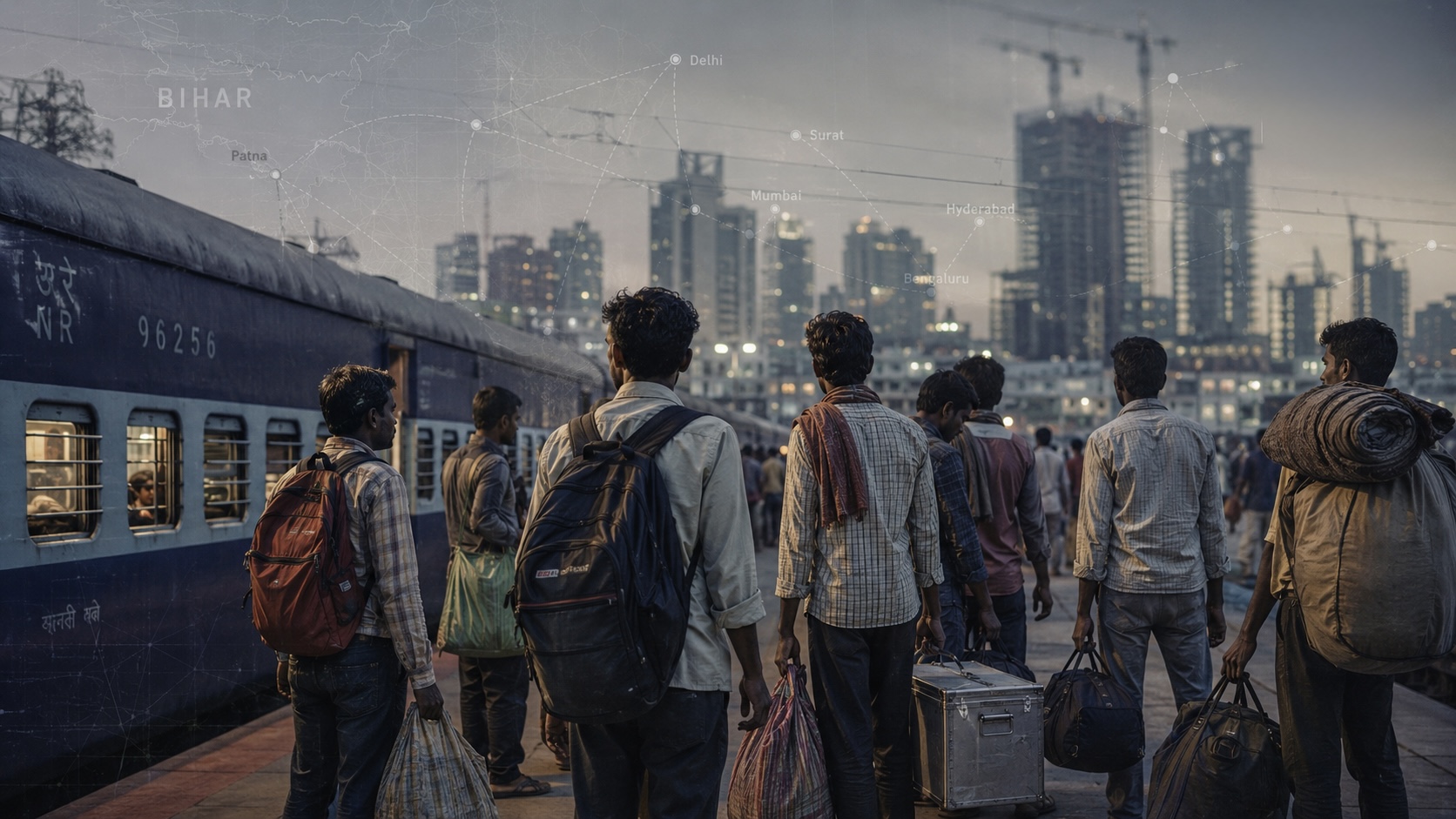
Migration in Bihar rarely begins as one grand decision. More often, it begins as arithmetic or pressure. A debt is outstanding. A sibling needs tuition fees. A parent’s prescription costs more than the last harvest covered. The village has work, but work is not the same as income, and income is not the same as security. Then someone mentions Surat or Delhi or Hyderabad. A cousin has already gone. A contractor knows someone who knows someone. A train ticket is bought, often without a written contract, often without anyone in government knowing it happened at all.
Migration as Economic Compulsion
Through conversations I have had, this calculus comes through plainly. The men laying bricks in Delhi and Gurugram are not dreamers. They are solving an equation. They left not out of ambition alone but because staying had become economically irrational. Outside Bihar, there was at least the possibility of a regular wage. Many still want to return, but return is contingent on a condition Bihar has not yet guaranteed: that coming home will not also mean giving up income, dignity, and stability. The problem is not that people leave. What follows from that are two obligations the state has been largely ineffective at meeting: first, to build real systems of protection for those already outside; and second, as is more often spoken of, to gradually build a Bihar where fewer feel they have no choice but to leave. It is important to understand that the stakes are not abstract. The tens of thousands of crores flowing back into Bihar from its migrants each year are huge parts of the economy, and for lakhs of rural households, they are how ends are met (RBI, 2023–24; Exim Bank of India, 2016).
Beyond the Politics of “Palayan”
Bihar’s political vocabulary for migration has long been dominated by a single word: palayan, indicative of flight, escape, abandonment. Every election season, leaders arrive with variations on the same promise: that they will bring Bihar’s sons home, that the trains will one day reverse direction. The instinct is naturally not entirely wrong. A state cannot build itself on exported labour indefinitely, and Bihar must eventually get to a place where it generates enough opportunity to keep more and more of its working-age population present and productive within the state economy. But that is the work of decades, not electoral cycles. And in the meantime, this framing gets the problem exactly backwards. The money these workers send back does not merely supplement Bihar’s economy. For millions of rural households, it is their livelihood and economy. Neglecting the tens of lakhs already outside, while promising to eventually bring them home, is not a development strategy. It is an abdication dressed as ambition.
The Scale and Structure of Migration
The scale demands precision. The Bihar government’s own 2025 estimate puts around 57 lakh Biharis living outside the state: 52 lakh for employment, 5 lakh as students (Times of India, 2025). Census 2011 put the figure closer to 74 lakh (Census of India, 2011). The real number is contested, and almost certainly undercounts the circular and seasonal migrants who keep no fixed address and appear in neither tally. Even at the conservative end, this represents roughly one in twenty Biharis working outside the state at any given time. Around 55 percent of male migrants from Bihar leave for work or employment-related reasons, more than double the national average (Sarkar, 2019). A 2024 Economic Advisory Council to the Prime Minister paper estimated India’s total domestic migrant population at around 40 crore (Economic Advisory Council to the Prime Minister, 2024). If movement of people is, as that paper put it, “a fundamental economic activity,” then migration policy is not charity. It is economic infrastructure that is important to acknowledge and use. The numbers make that case on their own. What they do not capture is what the current system actually does and looks like for the individuals inside it.
The Protection Gap
The first obligation, as mentioned, is protection. Laws exist, such as the Inter-State Migrant Workmen Act of 1979, providing for minimum wages, journey allowance, accommodation, and medical facilities (Government of India, 1979). But legislation without enforcement is just paper, and the enforcement gap here is vast. It is often largely discounted to keep the cost of hiring low for the businesses that depend on migrant labour, and the seasonal migrant navigating this alone has neither the knowledge nor the leverage to demand otherwise. When wages are withheld, there is no contract to invoke. When he is injured on a construction site, there is often no record he was there at all. When he is stranded mid-season, cheated on payment, or simply abandoned by a contractor who has moved on, pursuing any grievance means sacrificing next month’s employment to do it, and next month’s employment is next month’s remittance, and next month’s remittance is his family’s rent, his daughter’s school fees, his father’s prescription. The contractor disappears. The suffering lands in a household back in Bihar.
Add to this the social dimension. The hostility a Bihari identity can attract at destination cities is not constant or universal, but in instances it surfaces, and when it does, it can be deeply unsettling. Recent reported incidents across India have involved allegations of hostility or abuse directed at Bihari workers and migrants. The details of individual cases vary and must be treated carefully, but the wider anxiety they produce is real. For the seasonal migrant, with no roots, no registration, and no reliable network, wage insecurity and legal invisibility can be accompanied by social vulnerability too. Hence, stronger systems of help and protection are necessary.
Why Migrant Protection Is Also Economic Policy
Crucially, the political economy of migrant protection becomes impossible to dismiss. Bihar receives an estimated ₹13,000 crore annually in international remittances alone, according to RBI-linked state-wise remittance data (RBI, 2023–24). Older domestic remittance estimates have also identified Bihar, alongside Uttar Pradesh, as one of India’s major receiving states for inter-state transfers (Exim Bank of India, 2016). Taken together, tens of thousands of crores flow back into Bihar annually, sustaining household consumption and spending. The arithmetic is stark: when a migrant worker is injured, cheated, or killed outside the state, a household loses its primary earner and local consumption drops. Moreover, the families receiving those remittances vote in Bihar. The migrants themselves largely return for Chhath puja, for weddings, for elections. Any government that can credibly say it is protecting Bihari workers across India is speaking to millions of households simultaneously. Migrant protection is not compassion. It is economic self-interest with a moral logic attached, and politically, it is far more viable than the promise to stop migration ever was.
Building Systems That Actually Work
So what would real protection actually look like? Some policy architecture and schemes already exist. Bihar is the second-highest state for e-Shram registrations, with nearly 3 crore unorganised workers enrolled on the portal (Press Information Bureau, 2024).
The Bihar government launched the Pravasi Kamgaar app in 2025 to register migrant workers and connect them to social security information, with labour enforcement officers tasked to register at least 500 workers per month in each panchayat (Times of India, 2025). These are real steps. But registration is only useful if the worker knows what it gets him, and field research across construction sites in Maharashtra and Gujarat found that most workers either did not know about existing portals or did not know how to use them, with awareness largely limited to those connected to labour unions (BehanBox, 2024). One Nation One Ration Card has made food security portable. Bihar has a State Migrant Labour Accident Grant Scheme. The skeleton is there. What is missing is the muscle: stronger panchayat-level outreach that makes registration feel worth doing, faster compensation when something goes wrong, and stronger contractor accountability that moves from statute into practice.
The Informal Architecture of Migration
The contractor system is a critical node. Most migration from Bihar moves through informal intermediaries : labour agents, older workers who vouch for jobs, contacts who promise “kaam pakka hai.” Banning this outright is neither feasible nor desirable, since for now it performs a genuine job-matching function where formal placement infrastructure is currently weak. While contractors are required to obtain licences from both home and destination states, enforcement remains weak under the existing migrant labour framework (Government of India, 1979). Strengthening that, a credible blacklist for repeat offenders, better use of existing helplines, nodal contacts in cities where Bihari workers are concentrated, and faster follow-up in wage-dispute and accident cases , would shift the balance of power incrementally toward the worker without dismantling a system that, for all its flaws, is currently the one functioning.
There is also a less discussed leverage point. During COVID, JEEViKA’s village organisations conducted a state-wide survey identifying returnee migrant households, and over 50,000 women from migrant families were folded into self-help groups and supported through the full package of interventions (Bihar Rural Livelihoods Promotion Society, 2023). There is already documented convergence between JEEViKA and Bihar’s Labour department on migrant welfare. The reach into migrant-sending villages exists and is a low fiscally burdening leverage point. What has not happened is scaling this into a systematic link – welfare coordination, remittance-linked savings, emergency assistance for families when a worker is in distress.
Beyond Migration Management
Taking a broader and longer view though, managing migration better is a floor, not a ceiling. The second obligation, the longer and more difficult one, is to build a Bihar where migration becomes a choice rather than a compulsion. The political temptation is to overpromise, and perhaps electorally it is sometimes necessary. But the honest answer more accurately requires resisting the urge and simplicity of grouping everything under industry. Bihar is growing, but it will pragmatically take decades for it to become a very strong industrial state. The FDI figures are thin. The manufacturing base is nascent. Saying Bihar needs more industry is true but about as useful as saying Bihar needs less poverty. The real question is where the genuine leverage points are.
Bihar’s Untapped Advantages
What Bihar does have is considerable. Almost 58 percent of its population is below the age of 25, the highest proportion of any Indian state, with its demographic window likely to remain open longer than many ageing southern and western states (Census of India, 2011; UNFPA, 2023). This is a labour supply the rest of India will need, and Bihar has so far allowed other states to capture too much of the value from it. The Ganges belt is some of the most fertile agricultural land in South Asia. Bihar is the fourth-largest producer of vegetables and eighth-largest producer of fruits in India, with makhana now exported to the United States and Canada, and yet the state processes a fraction of what it grows (IBEF, 2025a; IBEF, 2025b). Cold-chain and processing capacity remain far below Bihar’s agricultural potential. Building them as investable supply chains is the kind of targeted, natural-advantage-led growth that does not require Bihar to compete with other states on their terms. Further, Bihar’s Skill Development Mission is already certifying existing trades, a huge section available, through Recognition of Prior Learning; scaling it further and linking it more tightly to placement, credit, and procurement is one of the more straightforward wins available. The Buddha Circuit, Nalanda, Rajgir, and the ghats of Gaya carry a cultural and spiritual gravity that draws visitors from across Asia, and recent policy has begun to recognise this more seriously. The harder task remaining is to convert that footfall into local employment and revenue through last-mile infrastructure, local enterprise, trained guides, homestays, transport, and visitor spending. Rural roads have expanded from 835 km in 2005 to over 1.17 lakh km today, and GSDP growth has outpaced the national average for three consecutive years (Bihar Economic Survey, 2024–25). The infrastructure is arriving. What is needed is a strategy sharp enough to take advantage of what Bihar already is to create jobs and not force outward migration.
The Long Road to Structural Transformation
Conversely, Bihar’s literacy levels, low female workforce participation, and credit-deposit ratio well below the national figure are real constraints, and acknowledging them is the basis of honest planning (Bihar Economic Survey, 2024–25). The gap between headline growth and household-level opportunity remains wide, and it is in that gap that the migration imperative lives. Closing it is the work of a generation. But the direction is a political choice.
The Choice Before Bihar
Bihar’s civilisational inheritance is not just sentiment but also instruction. From Magadha arose India’s first empire and one of the world’s most enduring religions. Nalanda drew scholars from across Asia for centuries. The intellectual confidence of this land does not need to be constructed. It needs to be met by governance serious enough to match it.
Kautilya wrote his Arthashastra in the kingdom of Magadha, Bihar’s very soil, advising his king in words that have outlasted twenty-three centuries: “Prajasukhe sukham rajnah, prajanam cha hite hitam” – in the happiness of his subjects lies the king’s happiness; in their welfare, his welfare. The worker leaving Patna at dawn, with a contractor’s phone number and a borrowed train ticket, is a subject the state has not yet made happy. The systems are buildable. The political incentive is real but the will is needed. Bihar has the land, the youth, the cultural depth, and now the infrastructure. But it is a choice, and it is Bihar’s to make.