Examining the implementation gaps, equity concerns, and institutional challenges within India’s flagship rooftop solar initiative.
India’s PM-Surya Ghar Muft Bijli Yojana marks a significant expansion of household-level renewable energy adoption and reflects the country’s broader transition toward decentralised clean energy systems. While the scheme has accelerated rooftop solar deployment and widened access to subsidised renewable energy, its implementation reveals important structural and institutional challenges. This article examines the scheme through the lens of equity, state capacity, and long-term sustainability, arguing that disparities in housing quality, digital access, administrative readiness, and distribution infrastructure risk producing uneven outcomes across regions and income groups. It further evaluates emerging tensions between rapid solar expansion and stakeholder interests, particularly concerning DISCOM viability and accessibility for vulnerable populations. Drawing on comparative evidence and implementation trends, the article proposes policy measures aimed at strengthening inclusivity, improving institutional coordination, and enhancing the long-term sustainability of India’s rooftop solar transition.
An Overview
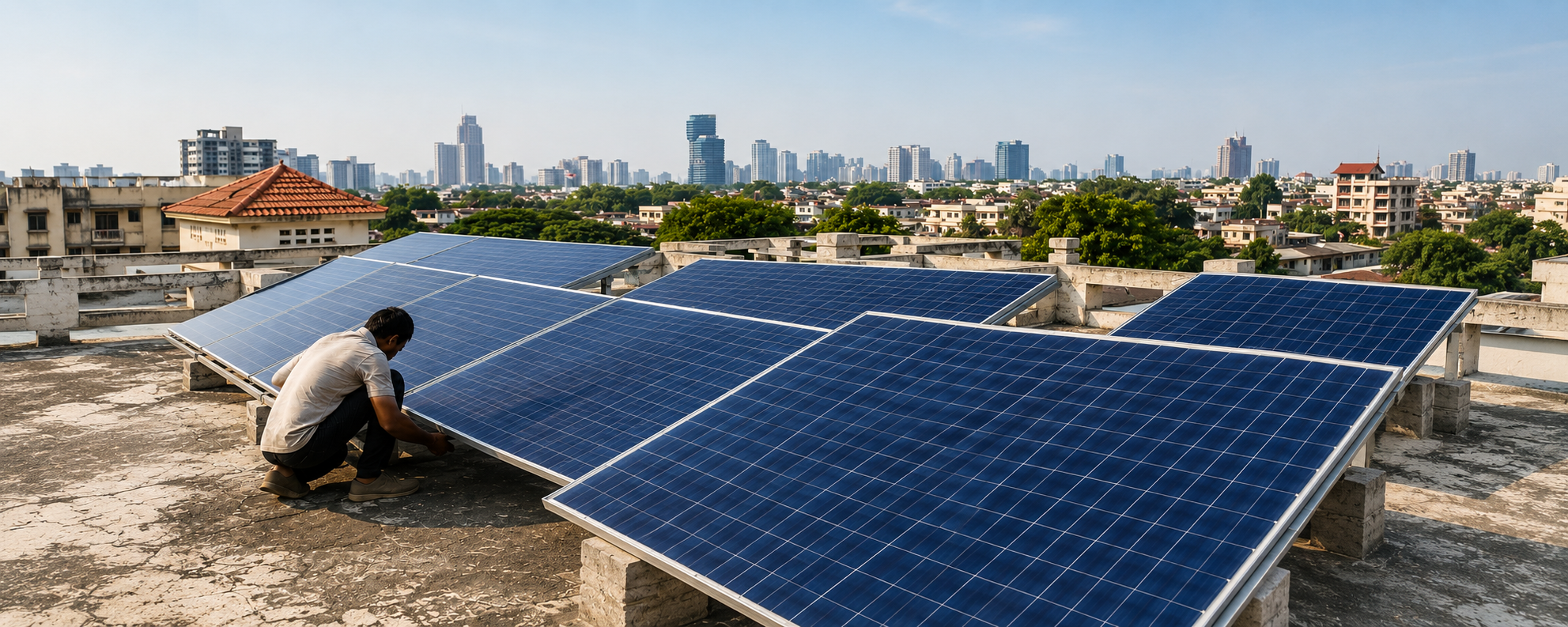
India’s strategic location within the global ‘solar belt’, between 40° South and 40° North, positions it among the world’s most favourable regions for harnessing solar energy. As of 2024, India ranks fourth globally in installed solar power capacity (India Brand Equity Foundation, 2025, p. 5). In line with this growing renewable energy transition, the Government of India launched the Pradhan Mantri Surya Ghar Muft Bijli Yojana (PMSGBY), one of the world’s largest domestic rooftop solar initiatives.
As of 10 March 2025, the scheme had crossed the milestone of ten lakh solar-powered households (Press Information Bureau, 2024). With subsidy disbursals amounting to ₹4,770 crore and over 6.13 lakh beneficiaries, the scheme has significantly expanded access to rooftop solar adoption (Press Information Bureau, 2024). Union Territories such as Chandigarh and Daman & Diu have reportedly achieved complete solarisation of government buildings, while states including Rajasthan, Maharashtra, Gujarat, and Tamil Nadu continue to contribute substantially to installation figures (Press Information Bureau, 2024). Simultaneously, India has begun tapping into its estimated solar power potential of 748,990 MW (NITI Aayog, 2025), reflected in the fact that the country’s installed solar capacity has increased twenty-six-fold over the last nine years, reaching 73.32 GW as of December 2023 (India Brand Equity Foundation, 2025).
Existing literature also highlights significant implementation variations across states. Dubey (2025), through a qualitative assessment of performance indicators, environmental outcomes, economic gains, and implementation gaps, identifies administrative bottlenecks, climatic challenges, logistical constraints, and limited digital access as key barriers affecting states such as West Bengal and Arunachal Pradesh. In contrast, states such as Maharashtra and Uttar Pradesh have demonstrated stronger implementation outcomes due to proactive state support and wider outreach efforts. These contrasting experiences underline the importance of state capacity and administrative efficiency in achieving national renewable energy targets.
Against this backdrop, the article critically evaluates the structural and institutional limitations within the scheme while proposing measures aimed at strengthening digital inclusion, administrative outreach, and implementation efficiency. It also incorporates comparative international practices to assess pathways for a more equitable and sustainable rooftop solar transition.
Programme Launch, Core Objectives and Resource Allocation
PMSGBY was launched by Prime Minister Narendra Modi on 29 February 2024 with the objective of enabling residential households to generate their own electricity through rooftop solar installations (Government of India, n.d.). The scheme carries a financial outlay of ₹75,021 crore and aims to provide free electricity of up to 300 units per month to one crore households by the financial year 2026–27 (Government of India, n.d.).
The programme reflects a cooperative federal structure in its implementation design. At the national level, implementation is coordinated through the National Programme Implementation Agency (NPIA), while State Implementation Agencies (SIAs) oversee state-level execution. The scheme also provides Central Financial Assistance (CFA) exclusively for the residential sector, offering a 60 percent subsidy for systems up to 2 kW capacity and a 40 percent subsidy for the subsequent 1 kW, subject to a cap of 3 kW (Government of India, n.d.). In monetary terms, this translates to approximately ₹30,000 for 1 kW systems, ₹60,000 for 2 kW systems, and up to ₹78,000 for systems of 3 kW or higher.
The scheme additionally allows households to select their preferred vendors for rooftop solar installation through a National Portal (NP), which provides technical specifications, vendor ratings, system-size recommendations, and related implementation support (Press Information Bureau, 2024). However, eligibility under the scheme remains conditional upon several criteria. Applicants must be Indian citizens, possess a suitable rooftop for installation, maintain a valid electricity connection, and must not have availed benefits under any other subsidy scheme.
Envisioning scope and sustainability
India’s renewable energy transition is unfolding at an unprecedented scale, with the country targeting 500 GW of renewable energy capacity by 2030. Solar energy already constitutes 44 percent of India’s renewable energy capacity and 20 percent of the total installed electricity capacity as of September 2024 (India Brand Equity Foundation, 2025). Within this transition, rooftop solar systems are expected to play a transformative role.
According to Powell, Sati, and Tomar (2024), rooftop solar systems possess the potential to generate nearly 1,000 billion kWh of electricity while reducing carbon emissions by approximately 720 million tonnes. The scheme also carries substantial economic implications at the household level. Based on MNRE estimates (2025), nearly 45 percent of beneficiaries are currently receiving zero electricity bills, depending on their consumption and energy generation levels. In addition to reducing household expenditure, the scheme enables consumers to sell surplus electricity back to Distribution Companies (DISCOMs), thereby generating supplementary income.
Dubey’s (2025) cost-benefit assessment further estimates that installations completed till 31 January 2025 have generated net savings worth ₹1,619.95 crore, with projected savings reaching ₹36,089 crore over the next twenty-five years. Simultaneously, projected carbon emission reductions of nearly 89.65 million tonnes over the same period position the scheme as a potentially important contributor toward India’s net-zero target for 2070.
State-wise performance trends reveal substantial variation. Gujarat emerged as the highest-performing state with a Performance Index (PI) score of 0.81, while Maharashtra, Uttar Pradesh, Kerala, and Rajasthan also demonstrated strong implementation outcomes (MNRE, 2025). Conversely, Arunachal Pradesh and West Bengal recorded significantly weaker performance, attributed to terrain barriers, erratic climatic conditions, and administrative limitations.
Beyond electricity generation, the scheme aligns with broader developmental objectives linked to Sustainable Development Goals (SDGs), particularly SDG 7 (Affordable and Clean Energy) and SDG 13 (Climate Action). One notable component includes the creation of at least one ‘Model Solar Village’ in every district, supported by an allocation of ₹800 crore (MNRE, 2025). The initiative also reflects broader goals of decentralisation and village self-reliance, echoing Gandhian principles of local empowerment. Additionally, the scheme is expected to generate nearly 17 lakh employment opportunities through capacity-building and training initiatives while simultaneously supporting domestic manufacturing under the Make in India and Aatmanirbhar Bharat initiatives (MNRE, 2025).
Stakeholder Dynamics and Systemic Gaps: A Critical Appraisal
Despite its ambitious objectives, PMSGBY continues to face multiple structural and implementation-related challenges. Existing international evidence suggests that household-level energy autonomy often disproportionately benefits higher-income groups. Powell, Sati, and Tomar (2024), drawing upon evidence from over twenty countries, argue that rooftop solar adoption frequently reproduces pre-existing income inequalities due to differential access to infrastructure and financial resources. Similar concerns are raised by EV (2024), which notes that subsidy-driven energy transitions in developing countries may inadvertently exclude economically vulnerable populations.
Within India, the scheme’s design itself creates certain exclusionary outcomes. One of the primary eligibility requirements is ownership of a structurally suitable rooftop. However, Census data indicates that approximately 1.77 million individuals in India remain homeless, effectively excluding them from the scheme’s benefits (Office of Registrar General & Census Commissioner; Ministry of Home Affairs, Government of India, 2021). Additionally, a significant proportion of surveyed housing structures continue to be composed of temporary or semi-permanent materials such as grass, wood, mud, plastic, and hand-made tiles, which are unsuitable for rooftop solar installation. These infrastructural realities reinforce existing urban-rural and income inequalities.
Another important stakeholder concern involves DISCOMs. While DISCOMs remain central to the success of the scheme, the present net-metering framework has generated concerns regarding financial sustainability. Under current arrangements, DISCOMs effectively function as unpaid storage and transmission intermediaries during non-peak hours without adequate compensatory mechanisms, thereby increasing operational and financial pressures.
Given these structural and institutional constraints, targeted policy interventions become necessary to improve the scheme’s long-term inclusivity and sustainability.
Strategic Recommendations for Impact
Integrating Housing and Rooftop Solar Policy
A stronger integration between PMSGBY and housing schemes such as PM-Awas Yojana could significantly improve the inclusivity of rooftop solar adoption. Since access to a structurally secure roof remains a prerequisite for participation, aligning housing and renewable energy policy would simultaneously address infrastructural vulnerability and energy access concerns. This approach also aligns with broader government discussions prioritising PMAY beneficiaries within rooftop solar implementation frameworks (Goswami, 2024).
Reforming Net-Metering Through Virtual Net Metering Models
The current net-metering framework requires substantial reform to balance stakeholder interests more effectively. A case study conducted by MNRE and USAID (2018) highlights the potential of Virtual Net Metering (VNM) systems, which could reduce transmission losses for DISCOMs while extending benefits to apartment residents, tenants, and group housing societies. International experiences from Australia and Massachusetts further demonstrate how VNM models can improve flexibility, incentivise shared ownership structures, and distribute costs more equitably across stakeholders.
Strengthening Digital Inclusion and Offline Access
Given the scheme’s heavy reliance on digital platforms for registration, vendor selection, and subsidy access, digital exclusion remains a significant implementation challenge. Dubey (2025) recommends expanding offline facilitation mechanisms through Common Service Centres (CSCs), particularly in underserved regions. State governments could further integrate digital literacy initiatives alongside PMSGBY awareness campaigns to address the gap between high registration rates and comparatively lower installation outcomes.
Expanding Local Institutional Participation
Finally, deeper engagement with Panchayati Raj Institutions, self-help groups, and local community networks could substantially strengthen grassroots implementation. Decentralised awareness campaigns and locally embedded outreach models would improve citizen participation, strengthen trust-building processes, and enhance the long-term sustainability of renewable energy adoption.
Conclusion
PM-Surya Ghar Muft Bijli Yojana represents one of India’s most ambitious efforts to democratise renewable energy access at the household level. However, the long-term success of the programme will depend not merely on installation targets, but on the state’s ability to address structural inequalities, improve implementation capacity, and balance competing stakeholder interests. As India accelerates its transition toward clean energy systems, the effectiveness of rooftop solar expansion will ultimately be determined by how inclusively, equitably, and sustainably that transition is governed.
References
Dubey, J. (2025). PM Surya Ghar: More Than a Climate Scheme. Bluekraft Digital Foundation. Read Here
EV, M. (2024, September 27). Addressing the Gaps in PM Surya Ghar Muft Bijli Yojana. Centre for Study of Science, Technology and Policy (CSTEP).
Government of India. PM Surya Ghar – Muft Bijli Yojana. National Portal of India. Read Here
India Brand Equity Foundation. (2025). Renewable Energy. Read Here
Ministry of New and Renewable Energy (MNRE). (2025, March 13). PM Surya Ghar: India’s Solar Revolution. Press Information Bureau. Read Here
Ministry of New and Renewable Energy (MNRE). (2025, February 12). PM Surya Ghar: Muft Bijli Yojana Turns One. Press Information Bureau. Read Here
Ministry of New and Renewable Energy (MNRE). (2025, February 2). Unstarred Question No. 305. Rajya Sabha. Read Here
Ministry of New and Renewable Energy (MNRE) & United States Agency for International Development (USAID). (2018). Case Study on Virtual Net Metering. Read Here
NITI Aayog. (2025). India Climate & Energy Dashboard. Read Here
Office of the Registrar General & Census Commissioner, Government of India. Census Tables. Census Digital Library. Read Here
Office of the Registrar General & Census Commissioner, Ministry of Home Affairs, Government of India. (2021, January 19). Primary Census Abstract Data for Houseless Population: India & States/UTs – District Level. Census Digital Library. Read Here
Powell, L., Sati, A., & Tomar, V. K. (2024, July 11). Surya Ghar: Energy Autonomy for Households in India. Observer Research Foundation (ORF). Read Here
Press Information Bureau. (2024, February 29). Cabinet Approves PM-Surya Ghar: Muft Bijli Yojana for Installing Rooftop Solar in One Crore Households. Read Here
RAAH does not take institutional positions on public policy issues; the views represented herein are those of the author(s) and do not necessarily reflect the views of RAAH.
About the Author

More from RAAH
Vision for Advancing and Anchoring Productive Sending of Income (VAAPSI)
Written by Divyansh Shah, Radhika Jain, Simin Sanil
This policy brief examines India’s remittance economy and proposes a structural policy framework to redirect remittance inflows toward productive investment.
Read the brief
School Merger and De-merger in Sikar District
Written by Ruchi Payal
Analyzing the challenges, access issues, and policy reversals of school consolidation in Sikar district, Rajasthan.
Read the note
An Evaluation of India’s ‘Millet Strategy’
Written by Divyansh Shah
India’s push to reposition millets as “smart foods” and climate-resilient crops has emerged as a significant component of its agricultural and food-security strategy.
Read the note
An Indian Reckoning to Modern Warfare Stratagems
Written by Priyal Jain
As warfare increasingly expands beyond conventional battlefields into cyber networks, information ecosystems, climate systems, and biological domains, India’s security architecture faces unprecedented challenges. This article examines the emerging contours of hybrid warfare and argues for a comprehensive restructuring of India’s strategic and institutional preparedness.
Read the note
Closing the Gig Gap: Why and How Should Policymakers Intervene to Boost Women’s Participation in the Gig Economy?
Written by Nikita Singh, Bhaskar Agarwal
India’s gig economy has expanded rapidly over the past decade and is projected to grow further.
Read the brief