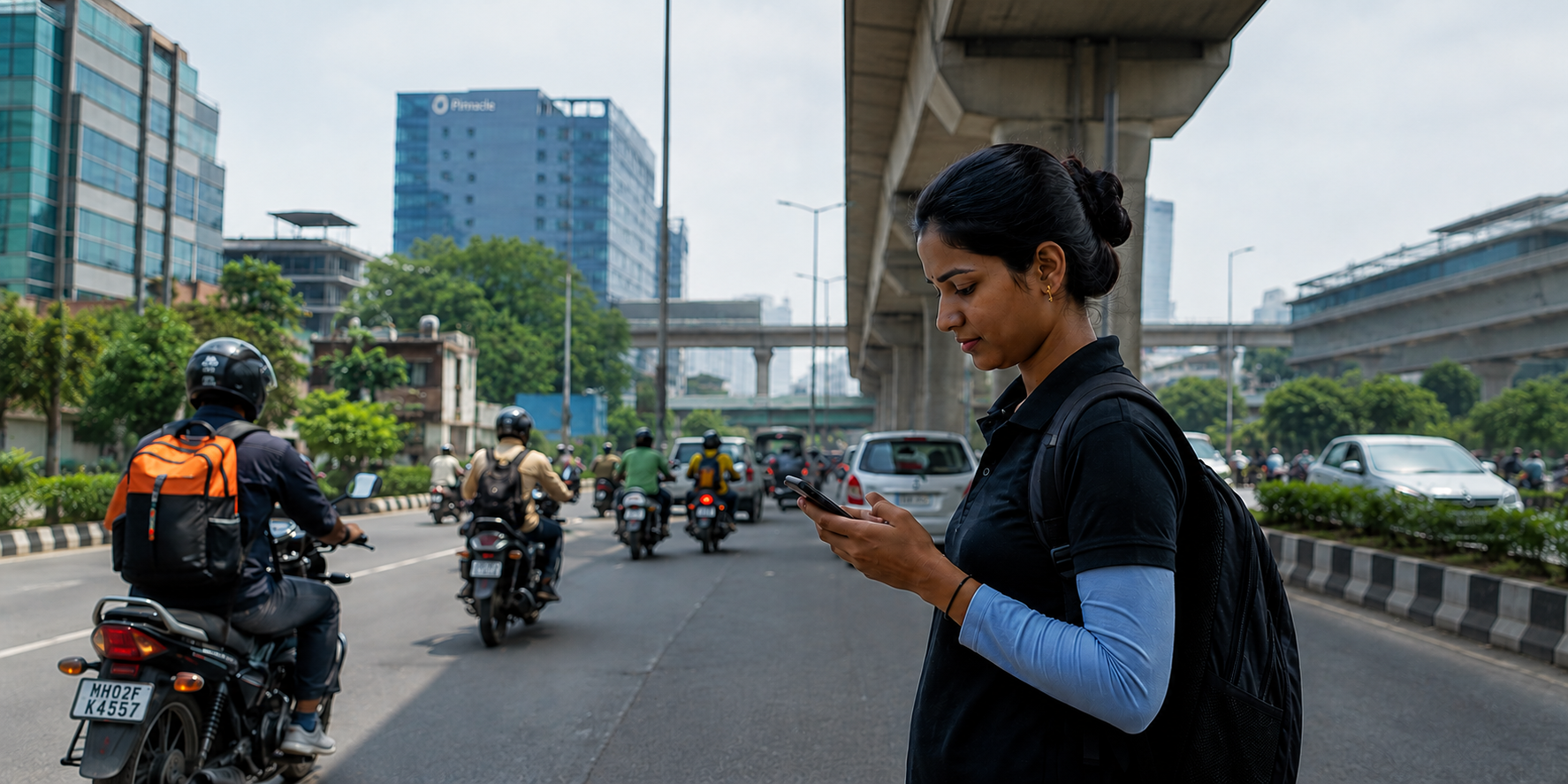
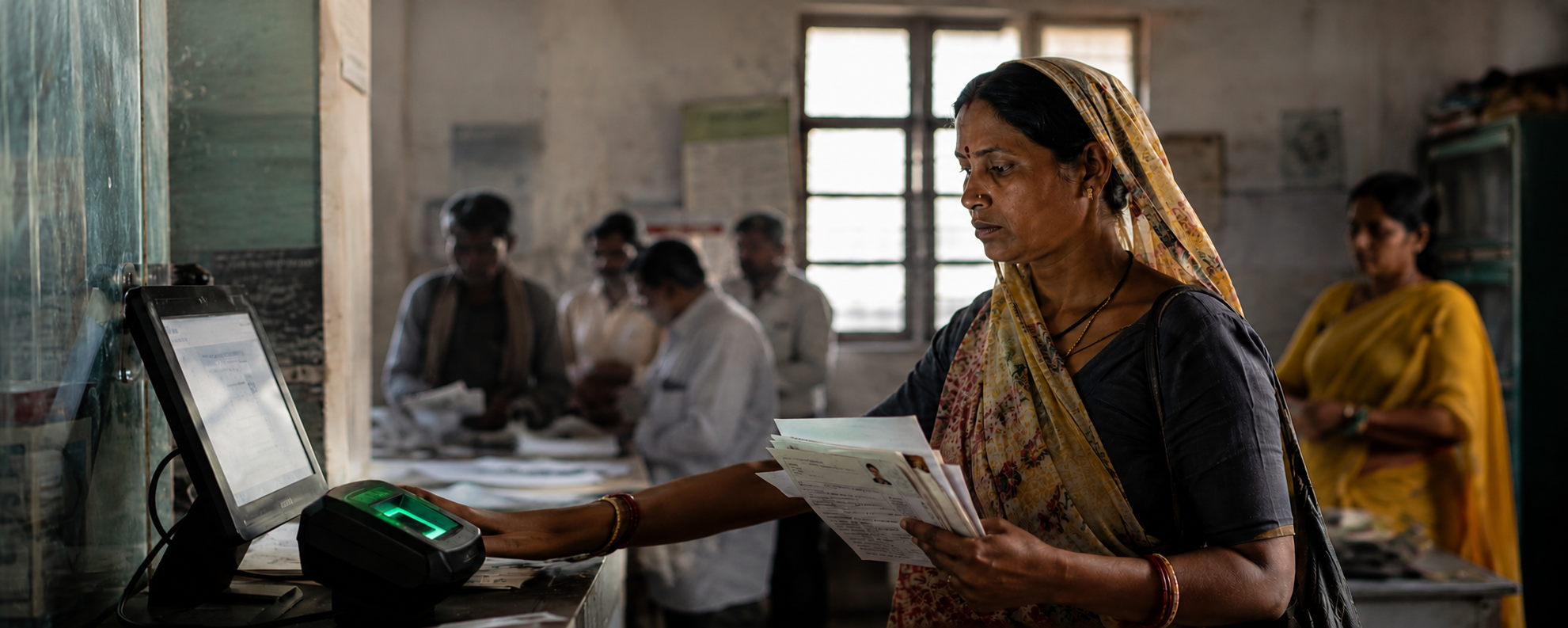
Nearly half (51%) of rural Indian women aged 15 and above lack mobile phones, a basic enabler of digital welfare access, underscoring how rapidly expanding Aadhaar-linked social programs risk excluding the very populations they intend to support. India’s digital welfare architecture, from e-Shram worker registries to Aadhaar biometric authentication for subsidies and pensions, was designed to reduce leakage and improve targeting. Yet, documented biometric authentication failures, data mismatches, and internet access deficits leave millions without entitlements they are eligible for, particularly informal women workers with lower digital access, literacy, and independent documentation. Studies show that digital barriers disproportionately affect informal workers, who comprise over 70% of the non-agricultural workforce, and women’s exclusion is compounded by socio-cultural constraints and device access gaps that undermine their ability to complete Aadhaar-linked registration and authentication processes.
Without robust offline alternatives and supportive digital literacy interventions, these systems risk transforming welfare from inclusive safety-net instruments into systemic exclusion mechanisms that weaken social protection and deepen gender inequities. To reverse this trend, policy architecture must reduce over-reliance on mandatory digital authentication where feasible, strengthen assisted registration and grievance redressal frameworks, and invest in gender responsive digital inclusion, including subsidised access to devices, community facilitation centres, and simplified identity reconciliation, so that Aadhaar functions as an instrument for inclusion rather than exclusion.
Given India’s ongoing scaling of digital public infrastructure and expansion of mandatory e-KYC requirements across several state welfare programs, timely design recalibration is critical to safeguard women’s access to essential benefits and realise the equity goals of India’s social protection agenda.
Policy Design Priorities
- Embed layered authentication pathways to minimise denial risks without compromising system integrity.
- Institutionalise assisted registration and grievance redressal mechanisms at the last mile, particularly for informal women workers.
- Expand gender-responsive digital inclusion infrastructure, including device access support and community facilitation models.
- Conduct periodic exclusion diagnostics and authentication audits to assess distributional impact across vulnerable groups.
About the Author

More from RAAH
Vision for Advancing and Anchoring Productive Sending of Income (VAAPSI)
This policy brief examines India’s remittance economy and proposes a structural policy framework to redirect remittance inflows toward productive investment.


 Divyansh Shah, Radhika Jain, Simin Sanil
School Merger and De-merger in Sikar District
Analyzing the challenges, access issues, and policy reversals of school consolidation in Sikar district, Rajasthan.
 Ruchi Payal
Powering Households or Deepening Inequality? An Analysis of PM-Surya Ghar Muft Bijli Yojana
Examining the implementation gaps, equity concerns, and institutional challenges within India’s flagship rooftop solar initiative.
 Neharika Gupta
An Evaluation of India’s ‘Millet Strategy’
India’s push to reposition millets as “smart foods” and climate-resilient crops has emerged as a significant component of its agricultural and food-security strategy.
Divyansh Shah
An Indian Reckoning to Modern Warfare Stratagems
Abstract: As warfare increasingly expands beyond conventional battlefields into cyber networks, information ecosystems, climate systems, and biological domains, India’s security architecture faces unprecedented challenges. This article…
 Priyal Jain